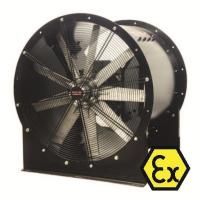
Explosion-proof fan systems are specialized ventilation solutions designed to provide safe ventilation in areas where potentially explosive atmospheres may occur. In industrial facilities, choosing suitable ventilation equipment is essential to help manage the risks posed by vapors, gases, solvents, and combustible dust, particularly in applications subject to ATEX requirements. Explosion-proof ventilation fans help extract air in a controlled manner and maintain airflow within the working environment. ATEX is the European Union regulatory framework setting out conformity and safety requirements for equipment intended for use in potentially explosive atmospheres.
An explosive atmosphere may form when vapors, gases, mists, or dust create an ignitable mixture with air under certain conditions. Therefore, selecting a fan with a high airflow capacity alone is not sufficient for ventilation systems in potentially explosive atmospheres. The fan must be suitable for the characteristics of the environment, the intended application, the equipment category, and the project's technical requirements.
When selecting an ATEX fan, describing a product simply as an “explosion-proof fan” is not enough. The hazardous-area classification, the type of gas or dust that may be present, the required pressure, airflow rate, motor specifications, and installation configuration must all be evaluated together. Under ATEX, conformity assessment and the intended use of equipment for potentially explosive atmospheres are subject to specific requirements.
One of the main objectives in hazardous areas is to control the likelihood of a flammable atmosphere coming into contact with an ignition source. Mechanical friction, electrical equipment, or unsuitable equipment design may create potential risks. For this reason, selecting motors, designs, and components appropriate for the operating conditions is critical in the manufacture of explosion-proof fans.
Not all potentially explosive atmospheres have the same characteristics. A production area containing chemical vapors has different requirements from a sugar or flour facility where combustible dust is generated. Therefore, the vapor, gas, or dust characteristics of the environment must be considered when selecting an ATEX-compliant fan. The hazardous-area Zone classification is also among the essential technical details used to assess product suitability.
When selecting a fan for a potentially explosive atmosphere, the required airflow rate and system pressure must be specified. Pressure losses caused by ducts, filters, grilles, and connecting components directly affect fan performance. In addition, the electrical supply, motor power, and operating conditions must meet the project's requirements.
ERF Group's explosion-proof fan range includes three main axial fan models with different housing designs and installation options. The EXPP-Y features a round housing, the EXPP-D has a square housing, and the EXPP-K features a tubular casing, providing solutions for different installation and application requirements.
The EXPP-Y Explosion-Proof Round-Housed Axial Fan is a round-housed axial fan specially developed for wall-mounted applications. It can be used in areas with potentially explosive atmospheres, including filling stations, oil refineries, tankers, and chemical storage facilities.
The EXPP-Y model is manufactured in accordance with EN 14986:2017, IEC EN 60079-0:2018, and ISO EN 80079-36:2016. Voltage options of 230 V / 400 V are available for motors up to 3 kW, while 400 V is offered for motors rated 3 kW and above. The stated ATEX markings include II 2G Ex db or eb IIC T4 / II 2D Ex tb IIIC T125 C Db and II 2G Ex h IIC t4 Gb / II 2D Ex IIIC T125 C Db.
The EXPP-D is a wall-mounted axial fan with a square housing. It is used in applications where potentially explosive atmospheres may occur, such as filling stations, oil refineries, tankers, and chemical storage facilities. The product is manufactured in accordance with EN 14986:2017, IEC EN 60079-0:2018, and ISO EN 80079-36:2016.
Voltage options of 230 V / 400 V are available for motors up to 3 kW, while 400 V is offered for motors rated 3 kW and above. The stated ATEX markings are II 2G Ex db or eb IIC T4 Gb / II 2D Ex tb IIIC T125C Db and 2G Ex h IIC t4 Gb / II 2D Ex h IIIC T125 C Db.
For projects requiring a tubular axial fan, the EXPP-K offers an explosion-proof axial design with a tubular casing. The product is manufactured in accordance with EN 14986:2017, IEC EN 60079-0:2018, and ISO EN 80079-36:2016. It is frequently selected for applications such as filling stations, tankers, oil refineries, and chemical storage facilities.
For the EXPP-K, 230 V / 400 V options are available for motors up to 3 kW, while the source text specifies “400C” for motors rated 3 kW and above (this requires verification). The stated ATEX markings are II 2G Ex db or eb IIC T4 Gb / II2D Ex tb IIIC T125 C Db and II 2G Ex h IIC T4 Gb / II 2D Ex h IIIC T125 C Db.
The volume of the area, system pressure losses, and required air change rate should be taken into account when selecting a fan. The correct airflow rate and pressure are essential for effective ventilation.
The fan should be selected according to its intended installation in a duct, wall, or another location. The appropriate solution should be chosen from round-housed, tubular axial, and square-housed models.
Motor power is determined by the required airflow rate and pressure. It is essential that the electrical supply matches the product's technical specifications.
The product's ATEX classification and marking must be considered when selecting a fan. The gas or dust atmosphere, temperature class, and Zone classification are important when assessing suitability.
The presence of vapors, gases, or dust directly affects fan selection. An ATEX fan must therefore be appropriate for the environmental conditions and relevant hazardous-area classification.
The characteristics of the conveyed air and the ambient temperature should also be evaluated. Material compatibility is particularly important in applications involving chemical vapors.
When purchasing an explosion-proof fan, factors such as motor power, ATEX classification, installation type, airflow rate, pressure, and operating environment should be evaluated together—not price alone. Explosion-proof fan prices may vary depending on product specifications and project requirements. With its EXPP-Y, EXPP-D, and EXPP-K models, ERF Group offers solutions for a range of ventilation requirements in potentially explosive atmospheres. Share your technical requirements with our specialist team to receive a quotation for the explosion-proof fan model best suited to your project.
Are explosion-proof fans and ATEX fans the same type of product?
These terms are generally used to describe the same product category. However, the product's compliance with applicable ATEX requirements and suitability for its intended application must always be verified.
Why is Zone classification important when selecting an explosion-proof fan?
Zone classification indicates the likelihood and persistence of a potentially explosive atmosphere. Fan suitability must be evaluated against that classification.
What motor options are available for explosion-proof fans?
In the ERF Group EXPP series, 230 V / 400 V options are available for motors up to 3 kW, while 400 V options are offered for motors rated 3 kW and above.
What technical information is required when ordering an explosion-proof fan?
Required information includes the application area, gas or dust characteristics, Zone classification, airflow rate, installation type, pressure, and electrical supply.
How can an explosion-proof fan's ATEX classification be verified?
The ATEX classification should be checked against the product's technical documentation and marking. The product specifications must correspond to the hazardous-area classification of its intended application.
In which gas and dust atmospheres can explosion-proof fans be used?
Fan suitability depends on the type of gas or dust, equipment group, Zone classification, and temperature class. A technical assessment is therefore required for each application.
How should ATEX markings on explosion-proof fans be interpreted?
ATEX markings should be assessed by considering the equipment group, category, gas or dust group, type of protection, and temperature classification together. This information must be compared with the hazardous-area classification of the intended application.