






OUR DOCUMENTS
Details on our quality policies and production standards.
View
Proper air circulation plays a critical role in maintaining consistent production quality and ensuring employee safety in modern manufacturing facilities. Particularly in large-scale industrial plants, airflow along the production line not only helps maintain suitable ambient conditions but also supports the controlled removal of dust, smoke, and chemical gases. However, airflow imbalances may develop over time in many facilities. This can negatively affect both production performance and energy consumption.
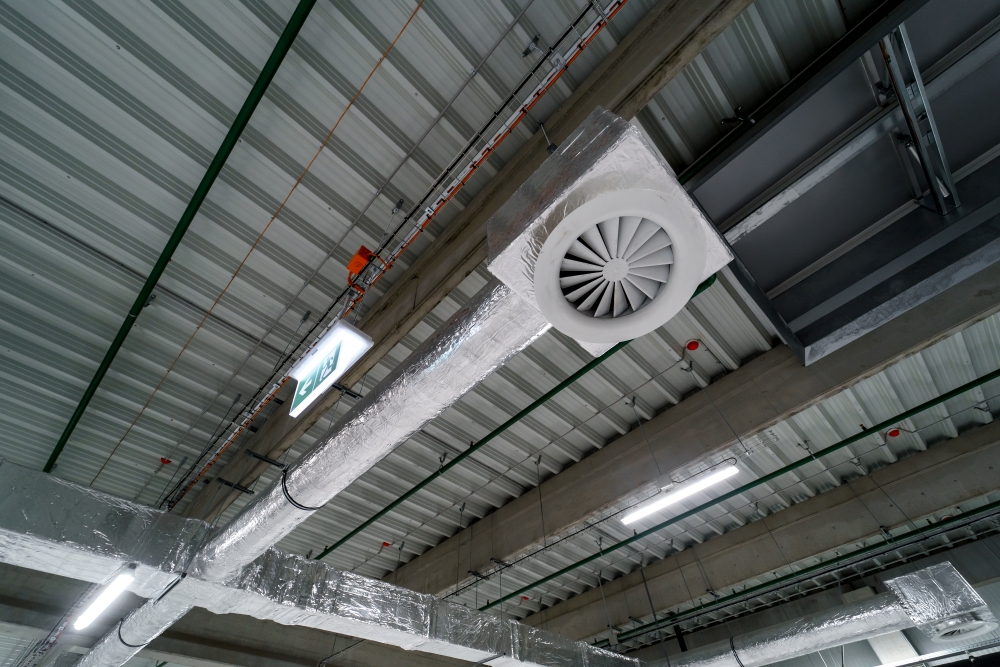
Industrial airflow problems are often caused by improperly designed ventilation infrastructure or irregular maintenance practices. Especially in facilities with high production intensity, factors such as increased heat loads, clogged filters, and improper airflow direction can lead to serious factory ventilation problems over time.
Industrial ventilation systems that are not professionally planned may cause excessive airflow to accumulate in certain areas while leaving other zones with insufficient air circulation. This creates an imbalance in production facility ventilation and directly affects working conditions.
Airflow problems in production areas generally occur when the system capacity is no longer sufficient to meet current production requirements. Particularly in manufacturing facilities that expand over time, the addition of new machinery, increased production intensity, or insufficient existing ventilation infrastructure can disrupt airflow balance.
The most common causes of problems in industrial ventilation systems include:
Particularly in high-temperature production areas, heat loads can significantly restrict air circulation and cause hot air to accumulate in specific zones. In addition, dust and chemical gases generated during production may increase system resistance.
Combined with these factors, inadequate production facility ventilation can gradually develop into serious operational problems that negatively affect both employee comfort and production quality.
Factory ventilation problems often develop when minor system issues gradually become more significant. Particularly in large-scale industrial facilities, incorrect engineering practices can lead to airflow imbalance. The most common system errors include:
Especially in filtration systems, standard fan solutions may become insufficient over time. For this reason, radial fan systems can provide more balanced performance in applications requiring high static pressure.
When airflow along the production line becomes unbalanced, not only ambient comfort but also production performance can be directly affected. Particularly in industries involving precision manufacturing, changes in temperature and air quality may compromise product standards. These conditions can contribute to airflow imbalance and lead to several operational effects.
The main effects of unbalanced airflow include:
In addition, when airflow problems persist for extended periods, production costs may increase and overall operational efficiency may decline significantly.
Selecting the right fan is highly important in professionally designed ventilation projects and can provide numerous benefits for production facilities. The required airflow rate and pressure level vary from one production facility to another. For this reason, facility-specific solutions should be preferred instead of standard systems.
In particular, radial fan systems can provide more efficient results in filtered systems that require high pressure, while axial fan solutions may be more suitable for various applications where high airflow rates are required across large areas.
Incorrect fan selection, on the other hand, can cause problems such as uneven air circulation, low performance, high energy consumption, and insufficient air transfer. Therefore, in industrial ventilation systems, fan capacity, duct configuration, and airflow resistance should be evaluated accurately.
To optimize airflow in production facilities, the existing system should first be analyzed in detail. Airflow measurements, temperature distribution, and duct performance should be checked regularly.
For more balanced air circulation in production facilities:
Particularly in large-scale facilities, production facility ventilation projects carried out with professional engineering support can provide more stable and efficient results.
Energy efficiency is a key consideration in modern industrial ventilation system solutions. Since continuously operating ventilation equipment can result in high energy consumption, selecting the right system plays a critical role.
To improve energy efficiency, high-efficiency motor systems should be used, inverter-controlled fan solutions should be preferred, filters should be cleaned regularly, airflow should be properly balanced, and system capacity should be calculated accurately. With a properly planned production facility ventilation system, energy costs can be reduced while creating a more sustainable production environment.
Erf Group develops professional industrial ventilation solutions tailored to the requirements of a wide range of industries. The solutions we provide at Erf Group include:
If you would like to reduce airflow problems on your production line, achieve more balanced air circulation, and improve energy efficiency, you can explore Erf Group’s professional ventilation solutions and obtain the information needed to evaluate the most suitable solution for your facility.


