






OUR DOCUMENTS
Details on our quality policies and production standards.
View
Providing effective air circulation in large enclosed spaces is extremely important for both operational efficiency and employee safety. In addition to traditional duct-based ventilation systems, jet fan technologies, which offer more efficient and flexible solutions, are now preferred in many projects. Especially in large areas such as industrial facilities, parking garages, warehouses, and tunnels, the use of jet fans in ventilation helps direct airflow properly and improves overall system performance.
A properly designed jet fan system not only supports the removal of polluted air but also contributes to easier installation, reduced energy consumption, and lower operating costs. For this reason, the advantages of jet fans have become one of the important evaluation criteria during the design stage of modern engineering projects.
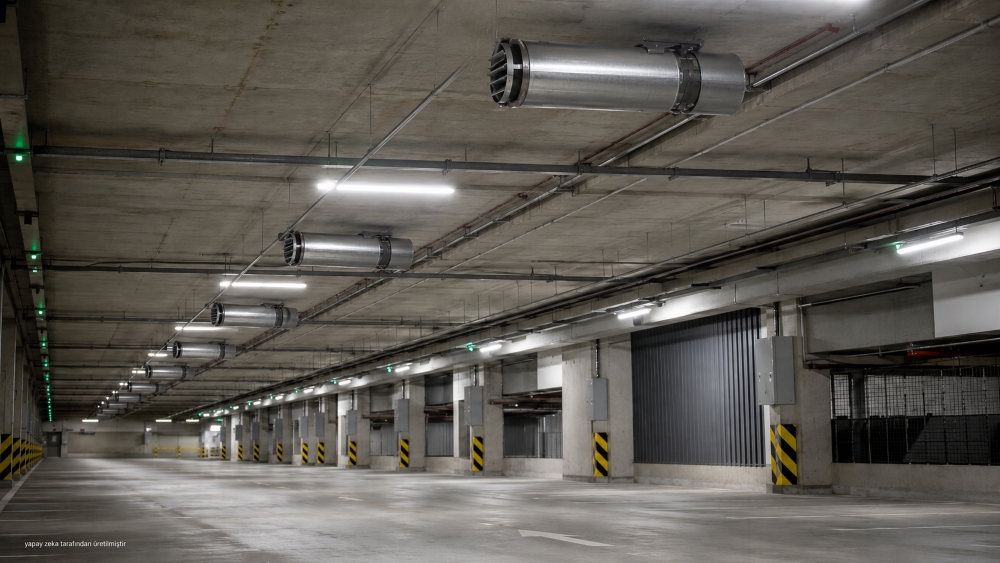
In traditional ventilation systems, air is transported through extensive duct networks, whereas in jet fan technology, airflow is directed directly by the thrust generated by the fans. This approach helps create a much more flexible ventilation infrastructure, particularly in large-volume structures.
With a well-planned system, air can be distributed evenly throughout the area without creating dead zones. As a result, hot air, exhaust gases, or pollutants can be removed within a short period of time. This feature provides an important advantage, especially in enclosed parking garages and production facilities where carbon monoxide control is important.
In addition, jet fan technology increases design flexibility during the project planning process because it can be applied without placing excessive constraints on the building architecture. Reducing the amount of ductwork allows ceiling space to be used more efficiently.
In modern ventilation projects, the advantages of using jet fans are not limited to technical performance. They also provide several benefits that directly contribute to operations. These advantages can be listed as follows:
The success of a ventilation system depends not only on the use of powerful equipment but also on the right engineering approach. Properly positioned jet fans allow airflow to be managed in a more controlled manner and help create balanced circulation throughout the system.
This prevents unnecessary equipment use while also optimizing energy consumption. In addition, the reduced need for ductwork shortens installation time and allows implementation processes to proceed more efficiently.
Especially in large-scale projects, airflow analyses and simulation studies help position fans in the most suitable areas, significantly improving system performance. In this way, more successful results can be achieved in terms of both the initial investment process and long-term operating costs. Properly planned jet fan solutions are among the important ventilation applications that contribute to sustainable building design.
Using fans with the same capacity or the same specifications in every project may not produce the right results. To achieve maximum performance, many factors, from system design to equipment selection, should be evaluated together.
First, the volume of the building, its intended use, and the required air change rate should be analyzed correctly. The airflow generated by the fans should be planned to operate in coordination with the exhaust points.
Selecting equipment with high motor efficiency, implementing regular maintenance programs, and integrating automation systems directly affect system performance. In addition, it is very important to determine fan installation positions in a way that does not obstruct airflow.
CFD analyses and engineering calculations carried out during the project stage can also help identify potential airflow problems before implementation. This approach improves system efficiency and reduces the need for possible revisions in later stages.
As a result, the advantages of jet fans do not arise solely from the technical specifications of the equipment; they result from the combination of appropriate equipment selection, proper project planning, and professional implementation processes. Ventilation systems planned according to specific requirements provide energy-efficient, safe, and long-lasting solutions, offering important contributions to businesses across different industries.
Choosing the right company is very important in order to benefit from the advantages of jet fans. When it comes to jet fan solutions, ERF Group is the single address for quality- and reliability-focused work. To experience the ERF Group difference backed by many years of experience, simply contact our expert team.


