






OUR DOCUMENTS
Details on our quality policies and production standards.
View
Smoke generated during a fire may pose a greater risk than the flames themselves. Reduced visibility, difficulties during evacuation and the spread of toxic gases make smoke control systems an essential safety component of modern buildings.
Smoke extract fans, one of the most important components of these systems, help transfer smoke outside the building in a controlled manner during a fire, contributing to the protection of life and property. However, for the system to operate effectively, the smoke extract fan must be selected in accordance with the building’s technical requirements and the relevant fire scenario.
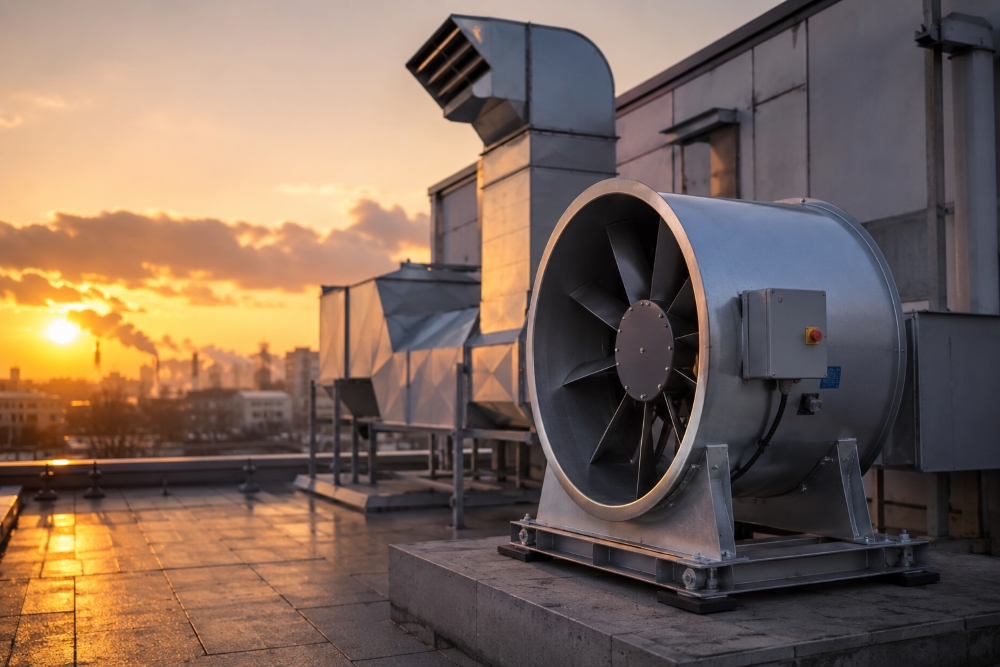
Hot gases and dense smoke generated during a fire can make it difficult for people to leave the building safely. Smoke extract fans direct smoke outside the structure, helping escape routes remain usable for a longer period.
These systems, also known as smoke exhaust fans, are important not only for evacuation safety but also for facilitating the intervention of firefighting teams. Particularly in large-volume buildings, smoke must be prevented from accumulating in specific areas so that the fire can be brought under control.
Fire regulations define various requirements, including smoke control systems, according to the intended use and size of a building. The primary objective is to create an environment that supports the safe evacuation of occupants during a fire.
Regulations generally require smoke extraction systems to be installed in certain types of buildings and specify that the equipment used must be resistant to high temperatures. For this reason, smoke extract fan selection should be based not only on ventilation requirements but also on the relevant fire scenario.
When selecting the right fan, evaluating airflow capacity alone is not sufficient. The main factors that should be considered include:
For example, the requirements of a system used in an enclosed car park may differ from those of a system installed in an industrial production facility. Therefore, project-specific engineering calculations should be carried out.
Standard ventilation fans are designed to transfer air under normal operating conditions. During a fire, however, temperatures may reach several hundred degrees. For this reason, fans used within a fire ventilation system must be capable of continuing to operate under high-temperature conditions.
If the fan stops operating prematurely, the smoke control system may lose its functionality. Therefore, high-temperature-resistant bearings, specially designed motors and heat-resistant casing structures are critically important.
The F300 and F400 classifications commonly used for smoke extract fans indicate the performance classes that define how long a fan can operate at specific temperatures.
F300-class fans are generally designed to operate safely for a specified period at a temperature of 300°C.
F400-class fans, on the other hand, can continue operating at a temperature of 400°C and are preferred in higher-risk applications. The appropriate class should therefore be determined according to the fire scenario and project requirements.
Using the same fan for every building is not an appropriate approach. For example, vehicle fires are taken into consideration in enclosed car parks, while high occupant density is considered in shopping centres. In industrial facilities, combustible processes are evaluated, whereas high-rack systems and loading areas are taken into account in logistics warehouses.
It may not be sufficient for a fan to operate for only a few minutes during a fire. Particularly in large buildings, evacuation and emergency response processes may take a long time. Therefore, the fan must be capable of maintaining its performance under high-temperature conditions for a specified period.
In systems without long-term operating capability, the fan may stop and cause smoke to spread rapidly. For this reason, operating duration should be considered as a selection criterion alongside temperature resistance.
Smoke extract fans are used in many different areas and provide significant convenience and advantages in the buildings where they are installed. The main types of buildings in which smoke extract fans are used include:
Enclosed car parks are among the most common areas in which smoke extraction systems are used. Dense smoke generated by vehicle fires may spread across large areas within a short period.
Jet fans and smoke extract fans are used together to ensure that smoke is discharged outside in a controlled manner.
Shopping centres are buildings with high visitor capacity. In the event of a fire, effective smoke control systems are required to prevent escape corridors and common areas from filling with smoke.
For this reason, high-capacity smoke exhaust fans are preferred.
The materials and equipment used in production processes may increase the risk of fire. Smoke extract fans support the safety of production areas while also facilitating emergency response processes.
In fires occurring in high-rack warehouses, smoke may rise and spread rapidly. Fan systems used in such buildings help extract smoke and maintain visibility.
Smoke control is critically important in tunnels. Smoke generated during a fire must be directed in a specific direction and extracted.
For this reason, high-performance and specially designed smoke extraction systems are used.
A smoke extract fan is a specialised ventilation fan used to transfer smoke and hot gases generated during a fire outside the building in a controlled manner.
It should be selected by considering the intended use of the building, the fire scenario, the required airflow capacity, the duct system and temperature resistance requirements.
Depending on the fan class used, they may have high-temperature resistance ratings such as F300 or F400.
Depending on the intended use, size and risk classification of the building, smoke control systems are mandatory in many types of structures.
High-temperature-resistant smoke extract fans and jet fan systems are generally used together.
Smoke extract fans are designed to operate under high-temperature conditions during a fire, whereas standard ventilation fans are not suitable for these conditions.
Engineering calculations are carried out by considering the fire load, building volume, amount of smoke generated, extraction time and duct pressure losses.
To ensure that the system will operate during a fire, the motor, bearings, connections, control panels and fan performance must be tested regularly.


