






OUR DOCUMENTS
Details on our quality policies and production standards.
View
Ventilation systems play a critical role in ensuring efficient, safe and sustainable operations in the maritime industry. Enclosed spaces, technical equipment compartments, engine rooms and accommodation areas on ships require continuous air circulation. Insufficient ventilation may lead to serious problems such as moisture accumulation, rising temperatures, equipment failure and reduced personnel comfort. For this reason, ship ventilation fans are among the most important components of modern maritime applications.
Properly designed marine ventilation systems do more than provide a supply of fresh air. They also contribute to the removal of harmful gases, temperature control and the safe operation of equipment. Ship fan systems developed specifically for different vessel types and areas of use are designed to withstand the demanding conditions of marine environments.
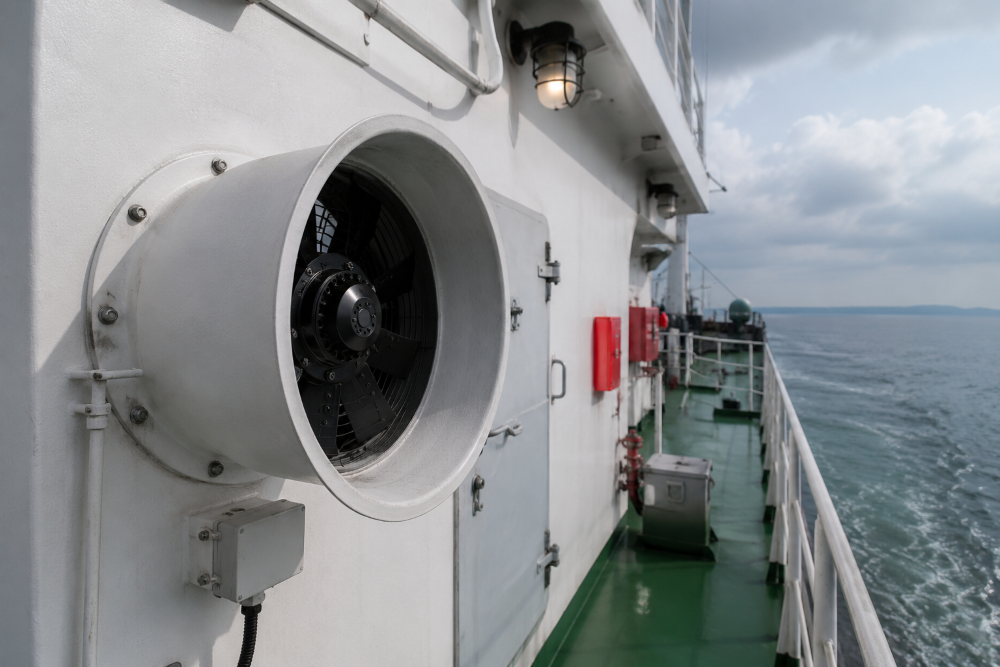
Ships operate for extended periods within enclosed and confined spaces. Maintaining indoor air quality is therefore essential for both equipment safety and personnel health. The primary objectives of marine ventilation systems include:
Ventilation systems are an essential part of operational safety, particularly on tankers, commercial vessels, container ships and military platforms.
Different areas of a ship have different ventilation requirements. The fan systems to be used should therefore be selected according to the characteristics of each area.
Engine rooms are among the areas exposed to the highest temperatures on ships. Generators, pumps, main engines and auxiliary systems generate considerable amounts of heat. Engine room ventilation helps to:
Durable, high-airflow fan systems are generally preferred in these areas.
Depending on the characteristics of the cargo being transported, humidity, temperature and air quality must be controlled within cargo areas. Cargo types for which ventilation is particularly important include:
Appropriate ventilation helps minimise cargo losses and deterioration in product quality.
Electrical panels, communication equipment, control systems and other electronic systems must operate within a specified temperature range. Ventilation systems used in these areas:
Special fan solutions that provide controlled airflow are generally used in technical areas.
Air quality is extremely important in accommodation areas used by passengers and crew members. Ventilation systems in these areas:
During long voyages, the efficient operation of ventilation systems in accommodation areas is critical to personnel health.
The type of fan used in marine applications is determined according to the required pressure level and airflow capacity.
Axial fans are widely preferred in applications requiring high airflow rates. Their common areas of use include:
They provide efficient and cost-effective solutions for low- and medium-pressure requirements.
Centrifugal fans are capable of generating high pressure and are frequently preferred for demanding applications. Their common areas of use include:
Thanks to their structure designed to withstand pressure, they can operate without significant performance loss.
In some marine applications, standard fans may not provide sufficient performance. Special fan systems are generally used in:
These systems are specifically designed for operations requiring high performance.
Marine environments are prone to corrosion due to their high salt and humidity levels. For this reason, the following should be prioritised when selecting a fan:
Each section of a ship has different airflow requirements. The required airflow rate and static pressure must therefore be calculated accurately during fan selection. Selecting an incorrect capacity may result in:
Available space on ships is highly limited. Fan systems must therefore be designed to fit the existing installation area. The following factors should be taken into consideration:
Compact designs provide a significant advantage in this respect.
Energy consumption is a major cost factor in ship operations. It is therefore beneficial to select high-efficiency fan systems. Features that contribute to energy savings include:
These features contribute significantly to reducing operating costs.
A correctly selected marine fan system provides numerous advantages. The main benefits include:
These advantages provide important benefits for both vessel operators and crew members.
The performance of ventilation systems used in the maritime industry depends not only on fan capacity but also on manufacturing quality and engineering infrastructure.
Operating conditions on ships involve demanding factors such as saline air, high humidity and continuous operation. For this reason, the selected fan systems must be designed specifically for marine applications.
At this point, ERF Group provides project-specific engineering support for different vessel projects through its experience in industrial and marine ventilation solutions. Our company develops solutions in line with the technical requirements of marine fan systems, ship ventilation fans, engine room ventilation and ship exhaust fan applications, with a focus on long service life and high performance.
Through a project-specific design approach, pressure requirements, airflow capacity, installation space and environmental conditions are analysed in detail to determine the most suitable system. This enables marine ventilation systems to operate more efficiently while optimising energy consumption. As a result, maintenance requirements are reduced and operational continuity is supported.
Meeting the high-quality expectations of the maritime industry, ERF Group adds value to projects through safe and sustainable ventilation solutions.
A ship ventilation fan is a mechanical ventilation device used to control temperature, provide air circulation and remove contaminated air from inside a vessel.
Ventilation is essential for ensuring the safe operation of equipment, protecting personnel health, preventing moisture formation and maintaining temperature control.
Axial fans, centrifugal fans and special high-pressure fan systems are among the most commonly used solutions in the maritime industry.
Depending on operational requirements, high-airflow axial fans and centrifugal fan systems capable of providing high pressure are generally used in engine rooms.
As saline air significantly increases the risk of corrosion, systems manufactured from corrosion-resistant materials and equipped with special protective coatings should be preferred.
Energy efficiency can be improved through high-efficiency motors, correct capacity selection, optimised fan designs and regular maintenance practices.


