






OUR DOCUMENTS
Details on our quality policies and production standards.
View
The iron and steel industry is one of the most challenging industrial fields due to intense dust, high temperatures, heavy-duty operating conditions, and continuous production processes. For this reason, it is not sufficient for ventilation equipment used in facilities to provide only air circulation. Systems that are resistant to high temperatures, deliver performance suitable for process requirements, and can operate continuously for long periods should also be preferred.
At this point, industrial fan solutions in the iron and steel industry play a critical role in terms of employee health, production safety, and process efficiency. A properly planned iron and steel plant ventilation system improves the working environment by ensuring the controlled removal of dust, hot air, and process-related gases generated in production areas. It also helps prevent equipment from overheating and contributes to production continuity.
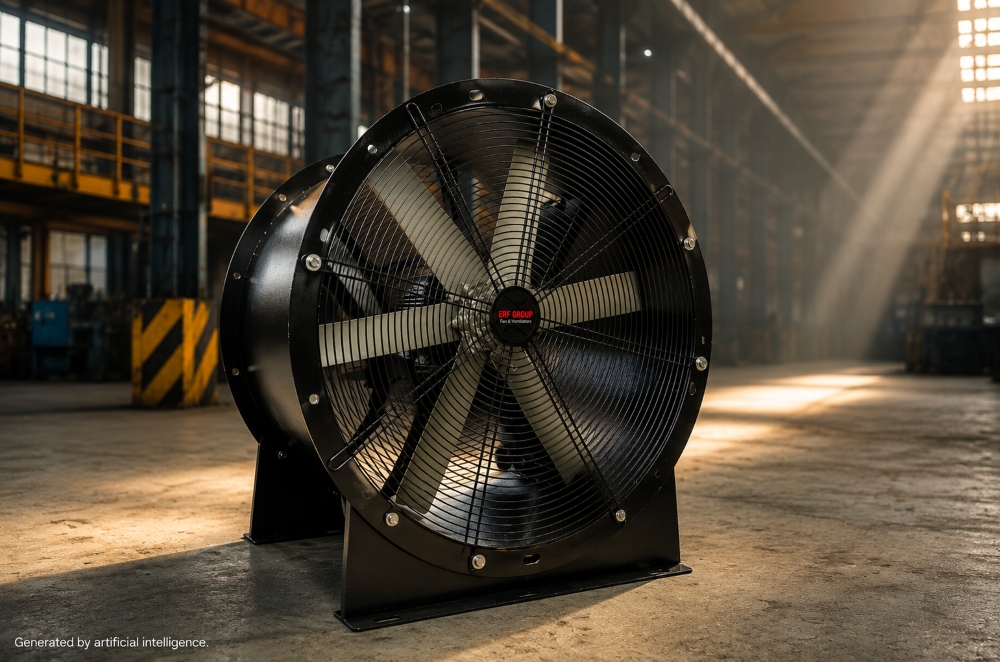
Although every industrial facility has different ventilation requirements depending on its operating conditions, iron and steel production plants have some of the highest engineering requirements in terms of fan selection. Therefore, it is very important that the equipment to be used is designed in accordance with the operating environment. The operating conditions that make fan selection difficult in iron and steel plants can be listed as follows:
High temperature: Temperatures can reach very high levels in rolling mills, melting furnaces, heat treatment sections, and annealing lines. Therefore, high-temperature industrial fan applications should be designed using materials resistant to high heat and appropriate motor protection systems,
Intense dust formation: Large amounts of metal dust may be generated during grinding, cutting, loading, and material transfer processes. The controlled removal of these particles from the environment is extremely important for both employee health and equipment safety. Therefore, process ventilation solutions require fan designs suitable for high particle loads,
Continuous operation: Iron and steel production plants generally operate on a 24/7 basis. The ability of fan systems to operate continuously for long periods is very important for maintaining production continuity,
Heavy-duty conditions: Mechanical loads, vibration, and challenging environmental factors directly affect the durability of fan equipment. Therefore, heavy industry ventilation systems should be manufactured with components that provide high mechanical strength and a long-lasting housing structure,
Corrosive gases: Corrosive environmental conditions and chemical gases generated in some production processes may shorten the service life of standard equipment. Therefore, fan housing and impeller materials should be selected in accordance with the operating environment.
In iron and steel production plants, fan systems are not used only for general ambient ventilation. They are used at different points according to the requirements of various processes.
The controlled discharge of high-temperature air generated at furnace outlets is very important for process safety. Fans used in dust collection systems help keep the working area clean by directing metal particles toward filtration systems.
Controlling dust generated on material handling lines, balancing ambient temperatures in rolling mills, and providing general ventilation in production areas are also among the applications in which fan systems are used.
Since fans with different pressure, airflow, and temperature values must be preferred for each of these applications, project-based engineering studies are of great importance.
Proper fan selection is an important engineering process that directly affects operating costs and system performance. Especially in ventilation projects for iron and steel production facilities, the following technical criteria should be evaluated as priorities:
Airflow: The amount of air to be handled by the fan should be determined according to process requirements and the volume of the production area. While insufficient airflow may negatively affect air quality, unnecessarily high capacity may cause energy losses,
Static pressure: A fan with an appropriate static pressure value should be selected by taking into account the resistance created by duct systems, filters, and other equipment. This criterion ensures that the system operates at the required performance level,
Operating temperature: The temperature to which the fan will be continuously exposed and emergency conditions should be evaluated separately. Motor and bearing systems resistant to high temperatures provide significant advantages in heavy industry applications,
Material selection: Appropriate steel grades or special alloys should be preferred by taking environmental factors such as corrosive gases, high temperatures, and metal dust into consideration. Proper material selection extends the service life of the equipment,
Fan housing: The housing should be designed to provide a robust structure, ease of maintenance, and vibration control. A housing design suitable for heavy-duty conditions increases system reliability,
Impeller structure: Impeller geometry should be determined according to the characteristics of the air to be handled. Durable impeller designs should be preferred in areas where abrasive particles are present,
Motor protection class: The motor’s IP protection level, suitability for operating conditions, and insulation class are very important for long-term continuous operation. High-efficiency motors also help reduce operating costs.
Heavy industry applications require much higher durability and performance than standard ventilation systems. ERF offers engineering-focused systems for different process requirements with heavy industry fan solutions developed in accordance with the challenging operating conditions of the iron and steel industry.
Fan designs with high-temperature resistance, efficient motor options, a robust housing structure, and a professional custom manufacturing approach enable ERF solutions to provide reliable performance in process ventilation, general ventilation, filtration systems, and exhaust applications. Through engineering calculations developed according to the needs of businesses, both the long service life of the systems is supported and energy efficiency is increased.
What types of industrial fans are used in iron and steel plants?
Depending on the application area, axial fans, radial fans, high-temperature fans, process exhaust fans, and fans suitable for filtration systems are preferred.
What types of industrial fans are used in iron and steel plants?
Depending on the application, axial fans, radial fans, high-temperature fans, process exhaust fans, and fans used in filtration systems are preferred in iron and steel plants. Fan selection is made according to airflow, static pressure, operating temperature, dust and particle concentration, and process requirements.
How should fans be selected for high-temperature environments?
Fans with motors, housings, impeller structures, bearings, and high-temperature resistance suitable for the operating temperature should be selected.
Why is fan material important in iron and steel plants?
Since high temperatures, corrosive fans, and abrasive gases may affect equipment service life, selecting appropriate materials is critically important in terms of durability and reliability.
How are airflow and pressure determined in industrial fan selection?
The production stage is determined through engineering calculations by taking airflow, duct resistance, air exchange requirements, and process requirements into consideration.
Why is maintenance important in continuously operating fan systems?
Periodic maintenance helps maintain energy efficiency, prevent performance losses, and reduce the risk of unplanned downtime.
Is it possible to select energy-efficient fans for iron and steel plants?
Yes. Fan solutions selected at the correct capacity, supported by automation systems, and equipped with high-efficiency motors help reduce operating costs by optimizing energy consumption.


