






OUR DOCUMENTS
Details on our quality policies and production standards.
View
Creating efficient working conditions in production facilities, protecting employee health, and ensuring the sustainability of production processes depend significantly on choosing the right ventilation system. At this point, the choice of a factory fan affects not only indoor air quality but also production efficiency, energy consumption, and equipment lifespan. Since the physical characteristics, production structure, and working conditions of each facility differ, fan selection must be based on technical criteria.
A properly selected industrial ventilation fan effectively removes dust, heat, smoke, and harmful gases from the environment, helping create safer working areas. Therefore, when selecting an industrial fan, it is necessary to focus not only on fan capacity but also on the needs of the facility and the intended use.
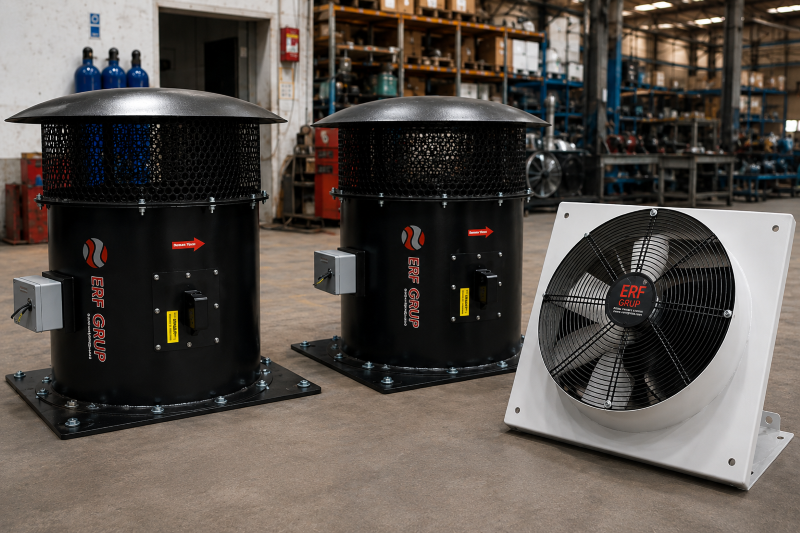
The main criteria to consider when selecting a factory fan can be listed as follows:
The first stage of the factory fan selection process is determining the airflow required by the environment. Airflow refers to the amount of air that needs to be moved within a specific period of time. The factors considered when calculating airflow include:
While a fan system with insufficient capacity may fail to improve environmental conditions adequately, an oversized system may increase energy costs.
When selecting an industrial fan, static pressure should be considered together with airflow. Particularly in facilities that use filtration systems, long duct lines, and air-cleaning equipment, the resistance encountered by the fan increases. Therefore, fans with suitable static pressure capacity should be selected by considering factors such as:
The architectural structure of each factory can vary significantly. The size of production areas, ceiling height, and airflow directions directly affect fan performance. The main factors that should be analyzed include:
These analyses make it possible to position the fan system in the most efficient way.
Some production facilities may be exposed to chemical conditions, high temperatures, or intensive dust formation. Therefore, the factory fan to be used must have technical specifications suitable for the working conditions. At this stage, the following factors should be evaluated:
Based on these criteria, the motor structure, fan housing, and materials used are determined.
Different production processes require different fan technologies. Therefore, the most suitable fan type should be selected according to the intended application.
Radial fans are systems that draw air from the center and discharge it outward at high pressure. Common applications include:
They provide effective performance in applications that require high pressure.
Axial fans move air along the axis of the shaft and provide high airflow rates. Their common areas of use include:
They are commonly preferred for providing air circulation in large areas.
Cabinet exhaust fans are compact systems particularly suitable for window or wall installation. Their areas of use include:
They provide efficient solutions for low- and medium-level ventilation requirements.
Blower fans are used in applications that require high-pressure airflow. Their common areas of use include:
They provide significant advantages in production processes that require strong and controlled airflow.
Metal and Steel Processing Facilities
Welding fumes, high temperatures, and grinding dust are generated in metal processing facilities. Therefore, highly durable radial fans and powerful exhaust systems are preferred.
Chemical and Paint Production Facilities
Chemical vapors need to be effectively removed. Fan systems manufactured from materials that provide resistance to corrosion are preferred in these facilities.
Food Production Facilities
Maintaining hygiene standards is highly important. Fan systems with stainless steel structures and solutions that provide controlled air circulation are preferred.
Plastic and Injection Molding Production Lines
The heat load generated by injection molding machines must be removed. Therefore, high-airflow axial fans are widely used.
Textile Factories
Removing dust and fibers generated during textile production from the environment is highly important. Radial fans integrated with dust collection systems are frequently preferred.
With energy costs continuously increasing, energy efficiency has become one of the most important criteria in the industrial fan selection process. The main points to consider for systems that provide energy savings include:
A properly designed system not only helps equipment operate efficiently for longer periods but also reduces energy consumption.
In addition to factory fan selection, the technical expertise and engineering support of the manufacturer are also highly important. Since the ventilation requirements of each facility are different, companies that can provide project-specific solutions rather than standard products should be preferred.
At this point, ERG Group develops solutions for the needs of different industries with its many years of experience in industrial ventilation.
Our company prioritizes efficiency, quality, and long service life in the industrial fan manufacturing process and supports industrial facilities with radial fans, axial fans, blower systems, and various ventilation equipment. By providing technical consultancy from the project planning stage through production and implementation, it helps businesses select the appropriate fan system.
Particularly in projects focused on high performance, energy efficiency, and reducing operating costs, ERF Group’s engineering approach contributes to the installation of efficient ventilation systems. In this way, the quality of the working environment is improved and production processes become safer.
When selecting a fan, airflow requirements, facility size, static pressure requirements, ambient temperature, and pollutants generated by production processes should be evaluated together.
The appropriate fan type varies depending on the needs of the facility. Axial fans are preferred for general ventilation, radial fans for applications requiring high pressure, and blower systems for specialized processes.
Selecting the correct capacity, using variable frequency drives, high-efficiency motors, and performing regular maintenance can significantly reduce energy consumption.
In metal processing, foundries, and similar high-temperature environments, specially designed heat-resistant radial fans and industrial ventilation fan systems are preferred.


