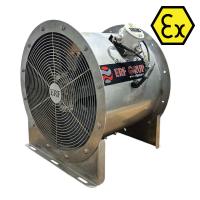
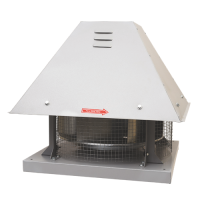
A ventilation fan, in its most general form, is mechanical equipment that enables air to be moved in a specified direction in enclosed or industrial areas. At ERF Group, we offer fan solutions that can be evaluated according to different airflow rates, pressure levels, installation requirements, and operating conditions.
Types of ventilation fans are classified according to the way air is moved, the installation location, and the requirements of the application. Different fan groups can be used together within the same facility; what matters is correctly determining the function of each fan within the system.
Axial fans are used in applications where large volumes of air need to be transported in a linear flow direction. This group, which creates air movement along the propeller axis, can be evaluated with different casing structures according to wall, window, duct, or special industrial applications. They may be preferred for moving ambient air or meeting exhaust requirements in areas such as factories, warehouses, and workshops.
Radial fans are used in systems where air needs to be directed radially after entering the fan. Especially in installations where ducts, filters, or similar resistances are present, the system's pressure requirement becomes important in fan selection. Therefore, a radial structure is evaluated by taking into account not only the amount of air but also the resistance created by the airflow path.
Duct fans are installed inside air ducts to support air movement along the duct line. These fans, which can be considered in projects where compact installation is important, should be selected together with the existing duct geometry and the total resistance of the line. In this way, the fan's operating point can be determined according to the actual requirements of the system.
Roof fans are used in applications where air needs to be transported from inside the building to roof level and discharged outside. They can be evaluated according to exhaust or special discharge requirements in factories, warehouses, car parks, and various industrial structures. Their installation on the roof provides a different solution for discharging indoor air; however, the discharge direction, airflow rate, and operating conditions should be evaluated together during selection.
Jet fans are used especially in large-volume areas where air needs to be moved in a specific direction. This fan group can be evaluated in solutions based on directing airflow. In the application project, fan placement, the objective of air movement, and the geometry of the area should be considered together.
Smoke and exhaust fans are selected for applications where smoke, contaminated air, or unwanted process air needs to be removed from the environment. In this case, not only the fan's airflow capacity but also the temperature and characteristics of the air in which it will operate should be taken into account. The temperature resistance and motor structure required by the application are important elements of product selection.
The applications of industrial ventilation fans are not limited to supplying air to an environment. Different fan solutions can be used in factories for hot air generated during processes, production-related contaminants, dusty or polluted air, and exhaust requirements.
Supporting air movement in warehouses, transferring process air in production areas, meeting exhaust requirements in car parks, and smoke extraction in suitable projects represent different usage scenarios. Fan selection can also be made according to environmental conditions in paint shops, workshops, greenhouses, and similar areas.
When the air contains chemical substances, material selection becomes important. In systems where hot air is discharged, the position of the motor within the airflow and its temperature resistance should also be examined separately. In this way, the fan is determined not only according to volume calculations but also according to the characteristics of the air in which it will operate.
When selecting a ventilation fan, the total pressure loss created by the system must be taken into account together with the airflow rate. One of the main factors determining the fan's actual operating conditions is the amount of air that needs to be transported; however, airflow rate alone should not be expected to be sufficient.
Components such as ducts, dampers, louvers, and filters create resistance to airflow. As the pressure losses created by these components increase, the pressure required from the fan also changes. Therefore, project calculations should determine not only the target airflow rate but also the total resistance of the airflow line.
Fan diameter, motor power, motor speed, propeller structure, and blade characteristics also affect operating characteristics. Conditions such as installation method, noise level, temperature, air composition, and operating duration are also included in the selection process. For example, a continuously operating system and a periodically used fan should not be evaluated in the same way during project assessment.
The basic parameters should be evaluated together during technical selection:
| Parameter | Corresponding Factor in the Project | Why Is It Evaluated? |
|---|---|---|
| Airflow rate | Amount of air to be transported | Determining the required air movement |
| Pressure loss | Duct and equipment resistance | Enabling the fan to overcome system resistance |
| Fan diameter | Air passage and product dimensions | Installation and capacity compatibility |
| Motor power | Drive requirement | Meeting the operating point |
| Temperature | Ambient operating conditions | Selection of motor and fan structure |
| Installation | Wall, duct, roof, or special installation | Determining physical placement |
The operating environment of the ventilation fan should be compatible with the fan's material, motor, and protection characteristics. Ambient temperature, whether the air is clean or contaminated, humidity, chemical content, and operating duration are taken into consideration during product selection.
For equipment to be used outdoors, environmental effects such as rain, dust, and wind should be taken into account. Corrosion-resistant material options may be evaluated for chemical environments. For hot air or smoke extraction, a structure suitable for the fan's operating temperature should be selected.
The installation area is also part of the operating conditions. Fans installed on walls, windows, ducts, or roofs have different connection and positioning requirements. Therefore, the physical conditions of the application area should be determined before fan selection.
When the purpose of the application and the direction of air movement are clarified at the beginning of the project, the fan group can be determined more easily; in this way, it becomes possible to prevent unnecessary capacity selection and the selection of products that do not meet the system's requirements.
In addition to the product's capacity and technical structure, ventilation fan prices vary according to the specific requirements of the project. Fan diameter, airflow rate, pressure, motor power, material, installation method, and custom manufacturing requirements may affect pricing.
Options such as filtered structures, stainless steel casings, Exproof production, high-temperature resistance, or project-specific dimensions are not evaluated within the same scope as a standard product. Therefore, when comparing prices, technical requirements should be considered together rather than evaluating only product size or motor power.
Ventilation fan models can be evaluated under axial, radial, duct, roof, and jet fan groups to meet different air movement requirements. At ERF Group, we approach product selection based on the airflow rate, pressure, installation, and environmental conditions required by the application.
The axial group may include solutions for wall, window, duct, and portable applications. Radial structures are evaluated in systems where pressure requirements are prominent, while duct fans are used in applications integrated into duct lines. Roof fans are evaluated in projects where air needs to be discharged through the building, while jet fans are considered in systems requiring directed air movement in large-volume spaces.
After the product group is determined, the fan's operating point should also be examined separately. In this way, not only the product category but also the function of the selected fan under the project conditions becomes clear.
| Fan Group | Main Factor to Be Considered in the Project | Installation Approach |
|---|---|---|
| Axial | High air movement requirement | Wall, window, or special application |
| Radial | System pressure | Duct-connected or special system |
| Duct type | Duct line characteristics | Inside the duct |
| Roof type | Discharge and outlet direction | On the roof |
| Jet fan | Direction of airflow | Within a large-volume area |
| Smoke/exhaust | Air temperature and characteristics | Special positioning according to the project |
At ERF Group, we first determine the requirements of the application when selecting a ventilation fan and then evaluate the product group that corresponds to these requirements. Airflow rate, system pressure, duct and equipment losses, installation method, temperature, and air characteristics constitute the main areas of our technical evaluation.
Depending on the project, a suitable option can be determined from axial, radial, duct, roof, jet, or smoke-exhaust fan groups. When special dimensions, materials, or operating conditions are required, the product structure can be evaluated in line with project requirements.
To determine the correct fan group for your ventilation system, you can share your project conditions with our technical team and receive a product and quotation evaluation according to the required airflow and pressure values.
Where are ventilation fans used?
They can be used in factories, warehouses, car parks, workshops, greenhouses, and various industrial ventilation applications.
What is the difference between a ventilation fan and an exhaust fan?
The terminology may vary depending on the application; in technical selection, airflow rate, pressure, and intended use are taken as the basis.
How is an industrial ventilation fan selected?
Airflow rate, pressure losses, environmental conditions, installation, and operating duration are evaluated together.
Why is airflow rate important in ventilation fan selection?
It is one of the main selection parameters because it determines the amount of air that needs to be transported by the fan.
What does the pressure value indicate in ventilation fans?
It indicates the operating capacity required to overcome the air resistance created by ducts and equipment.
For which areas is an industrial ventilation fan suitable?
It can be used in industrial areas where production, storage, process, exhaust, and air transfer are required.
Which features affect ventilation fan prices?
Airflow rate, pressure, diameter, motor, material, installation, and custom manufacturing requirements may affect the price.