Axial fans are used in ventilation applications where high volumes of air need to be moved efficiently. At ERF Group, we provide axial fan solutions for different installation configurations, operating conditions and airflow requirements.
Axial fan models are available with different casing, impeller, motor and installation configurations depending on the application and operating conditions. The appropriate fan design should be selected according to the required airflow, pressure and environmental conditions.
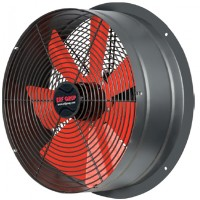
EKAP is a direct-driven axial fan designed for applications such as fresh air supply, general exhaust ventilation, stairwell and elevator shaft pressurization, and smoke extraction.
Standard diameters range from Ø300 to Ø1250 mm, with custom production available up to Ø2000 mm depending on project requirements. The airflow range is 3,500–150,000 m³/h.
The fan features cast aluminium airfoil blades, a cylindrical steel casing and a motor suitable for speed control via a frequency inverter. F300 and F400 motor options, as well as plastic impeller configurations, are also available.
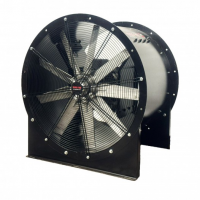
EKAP-C is designed for applications requiring high airflow where relatively high system pressure losses are also present.
The adjustable blade angle of the cast aluminium impeller allows the fan to be configured according to different airflow and pressure requirements. Its cabinet incorporates 20 mm foil-faced rock wool insulation to support lower noise levels.
Depending on project requirements, motor options capable of operating at 200°C, 300°C or 400°C for up to 120 minutes can be selected.
EKAP-B is designed for applications involving hot, smoky or contaminated air. Its bifurcated construction positions the motor outside the main airstream, separating it from the conveyed air.
Standard production ranges from Ø300 to Ø1250 mm, with custom diameters available up to Ø2000 mm. Airflow capacity ranges from 3,500 to 150,000 m³/h.
This configuration is particularly suitable for projects where isolating the motor from the transported air is an important design requirement.
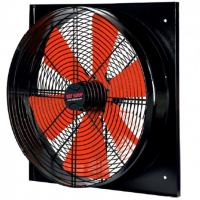
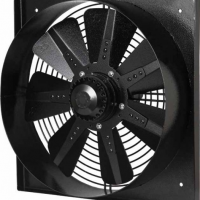
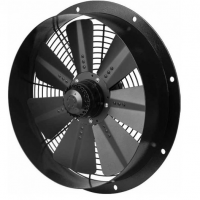
EPAY and EPAK are externally mounted motor fans designed for direct wall installation and applications requiring high airflow.
EPAY features a round casing, while EPAK is manufactured with a square casing. Aluminium or plastic impellers can be selected depending on the application. F300, F400 and Ex-Proof configurations are also available.
Standard sizes range from Ø300 to Ø1250 mm, with custom production available up to Ø2000 mm according to project requirements.
EPAK-T is designed for temporary ventilation applications where the fan needs to be moved between different working areas instead of being permanently installed.
Its wheels and carrying handle make repositioning easier on site. The fan has an all-metal casing, an electrostatic powder-coated surface and a stable base structure.
The maximum production diameter is Ø450 mm, with aluminium or plastic impeller options available.
EYST and EYSM models feature round casings, while EDST and EDSM models are manufactured with square casings.
These fans can be installed on walls or windows and are suitable for applications in factories, warehouses, paint shops and production facilities.
Externally mounted motor configurations are available with single-phase or three-phase motors. Thermally protected motors with copper windings can also be selected according to model requirements.
EKDR is a square-cased fan, while EYDR features a round casing. Both are externally mounted motor fan models designed to provide high airflow in a compact structure.
They can be installed on walls or windows and feature metal casings, electrostatic powder coating and protective wire guards.
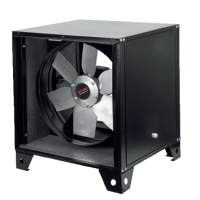
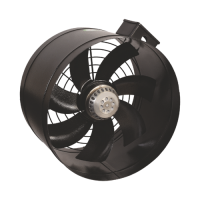
EYBT is an inline axial duct fan designed for applications where installation space is limited but high airflow is required. Its metal casing and thermally protected motor with 100% copper windings make it suitable for duct installations and greenhouse ventilation applications.
EKMS, on the other hand, is a mobile fan solution with a wheeled structure that allows high-volume airflow to be directed to different areas as required.
The applications of axial fans vary depending on fan design and the airflow requirements of the system. The ERF Group product range includes solutions for wall, window, duct and portable installation, as well as applications involving fresh air supply, exhaust ventilation, pressurization and smoke extraction.
In factories, warehouses, paint shops and manufacturing facilities, suitable axial fan models can be used for general air movement and exhaust ventilation. For construction sites and maintenance operations, portable fans can provide localized air circulation without requiring a permanent ventilation installation.
For stairwell and elevator shaft pressurization systems, purpose-designed solutions such as the EKAP range can be considered according to project requirements.
In applications involving hot, smoky or contaminated air, both motor position and temperature resistance should be evaluated carefully. The EKAP-B series is specifically designed to keep the motor outside the main airstream under these operating conditions.
| Application Condition | Fan Feature to Consider | Project Consideration |
|---|---|---|
| Fixed wall installation | Casing geometry | Round or square casing selection |
| Duct installation | Compact construction | Existing duct dimensions |
| Portable use | Wheels and carrying handle | Frequency of relocation on site |
| Hot air | Motor temperature resistance | Operating temperature and duration |
| Smoky or contaminated air | Motor separated from the airstream | Characteristics of the conveyed air |
| Pressurization | Airflow and pressure compatibility | System pressure losses |
The main technical parameters that influence axial fan performance include airflow, static pressure, fan diameter, motor power, motor speed, impeller design, blade angle, material, sound level, temperature resistance and installation type.
These parameters should not be evaluated independently. Fan selection should be based on the complete operating conditions of the ventilation system.
Airflow indicates the volume of air the fan can move within a given period and should be sufficient for the ventilation requirement. Static pressure represents the fan's ability to overcome resistance created by components such as ducts, filters, grilles and other system elements.
For this reason, both the required airflow and the system pressure loss must be considered when selecting an industrial axial fan.
Fan diameter and motor power should also be evaluated together. Motor speed, impeller geometry and blade angle affect airflow and pressure characteristics. Casing and impeller materials should be selected according to environmental and operating conditions, while sound level and temperature resistance should be considered according to the specific application.
| Technical Parameter | Relevance to the Project |
|---|---|
| Airflow | Volume of air that needs to be moved |
| Static pressure | Ability to overcome system resistance |
| Fan diameter | Air passage area and overall fan dimensions |
| Motor power | Required drive capacity |
| Motor speed | Fan operating characteristics |
| Blade angle | Airflow and pressure performance |
| Sound level | Acoustic requirements of the installation |
| Installation type | Wall, window, duct or portable installation |
Axial fan prices are determined by more than a single technical specification. The final cost depends on the fan configuration and the operating requirements of the project.
Fan diameter, airflow capacity, pressure requirement, motor power, motor type, impeller material, casing construction, temperature resistance and custom manufacturing requirements are among the main factors that can affect axial fan pricing.
For example, the technical requirements of a standard wall-mounted axial fan differ significantly from those of a fan intended to operate under high-temperature conditions.
F300, F400 and Ex-Proof configurations, different impeller materials, larger diameters and project-specific operating conditions may all affect the scope and pricing of the selected fan.
For this reason, axial fan prices should be assessed based on the complete technical requirements of the ventilation system rather than only fan diameter or motor power.
At ERF Group, axial fan solutions are evaluated with a project-based approach that considers the actual airflow requirements and operating conditions of each application.
As an axial fan manufacturer, we can configure different fan diameters, impellers, motors, casing structures and installation options according to project requirements.
When selecting industrial axial fans, we evaluate airflow, static pressure, operating temperature, installation configuration and environmental conditions together. This enables the selected fan configuration to be matched more closely with the actual operating requirements of the ventilation system.
Axial fan selection should therefore not be based solely on airflow capacity. System resistance, motor characteristics, installation conditions and the properties of the conveyed air should also be considered.
Different axial fan models can be evaluated according to these technical requirements. Contact ERF Group for technical evaluation, product selection and quotation support for your industrial ventilation project.
Axial fans can be used in factories, warehouses, paint shops, manufacturing facilities, greenhouses and construction sites, as well as in suitable pressurization, fresh air, exhaust and smoke extraction applications.
Industrial axial fans are generally used in ventilation applications that require high-volume airflow, including exhaust ventilation, fresh air supply, air circulation and suitable pressurization systems.
Yes. Axial fans can be used in smoke extraction applications when the appropriate fan construction and motor temperature rating are selected according to the operating conditions and project requirements.
Axial fan prices may vary according to fan diameter, airflow, pressure requirement, motor specifications, impeller material, casing construction, temperature resistance and custom manufacturing requirements.
Depending on the model, metal casing structures and aluminium or plastic impeller options can be selected according to the application requirements.
Operating temperature, exposure duration, motor temperature rating and the position of the motor relative to the airstream should be evaluated together when selecting a fan for high-temperature applications.